
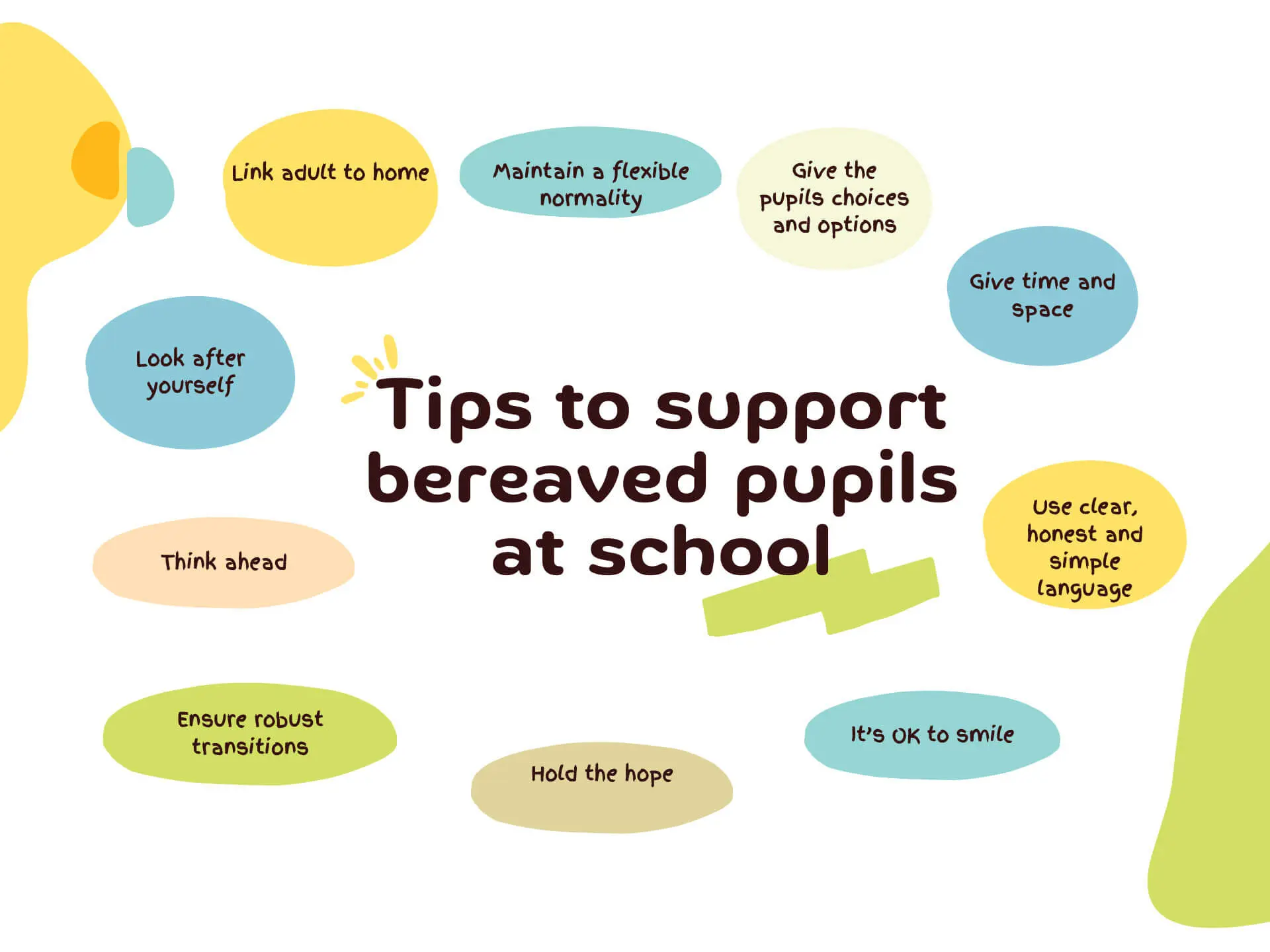
Picture of the tips for supporting bereaved pupils
Supporting bereaved pupils at school
Most grieving children/pupils do not need a ‘bereavement expert’ they need people who care and will be there for them, over time. Schools, by carrying on with their normal day-to-day routines, can do a huge amount to support a grieving pupil.
Staff can help by listening and providing the time and space to enable children to use different ways to cope with some of the changes in their lives.
The following tips may be useful when supporting bereaved children and families at school.
It is helpful to have one ‘link adult’ who can regularly keep in contact with the child’s family/home. Knowing what the child or young person has been told about the death and then what they understand is vital information. These two things can quite often be very different. See What do children understand at different ages and stages for more information. Be aware of how the family culture or belief systems shape the way death is understood and what language is being used with the child.
When everything else may feel like it has fallen apart, school and the people within it can offer a sense of security and continuity. School can provide a protective environment away from the overwhelming emotions and changes experienced in a grieving family. Ensuring normality with care and compassion is key.
Adapting timings and structures of the school day may need to be part of the plans for supporting a pupil and the family. Reviewing plans regularly with the child and family will support their journey of grief. Be aware that everyone will grieve in their own way.
Adults should avoid making assumptions about what the child should be doing, how they should be feeling or what is going to help. Remember that everyone’s grief journey is as unique as they are!
When things feel out of control, giving a choice or option to a child brings some control back into their life. Ask them what they would like to happen and who they would like to support them.
Some children may want to keep a transitional object or photo in their bag/pocket that reminds them of their special person. Older children may need to use a ‘time out card’ or a mood stone to indicate when they are feeling overwhelmed and need to go to a safe space. They may not want to talk, but just need some time to draw, write or just be quiet. These small choices can help pupils to find ways to manage the school day.
Grieving children need time and space to express their feelings safely and to be the children they are. Trusted adults can offer a safe place to talk about their thoughts and feelings.
Children often hide their own grief and appear to be OK! It is so important that they have a safe environment where they can learn to express this grief in different ways and the option of not needing to talk or answer lots of questions if they do not want to.
Children jump in and out of their grief and so taking the child’s lead is important. You can find more information on puddle jumping here.
Children often feel grief in their bodies- somatic symptoms. The feelings they are experiencing are often a complex mixture of fear, tiredness, stress, sadness, guilt, anxiety and anger. It is important to validate all these feelings as a normal reaction to grief.
Sometimes it is easier for young people to talk if they are doing an activity at the same time. Visit our activities page for children and young people and consider setting up a bereavement group in your setting.
People often feel worried that they will say the wrong thing, but children tell us that the worst thing to say is nothing. In general, children have a much greater capacity to deal with the harsh realities of life than we realise, if they are told in an age-appropriate way using clear language.
When a child doesn’t understand something, they often fill in the gaps with their imagination, which can make it even more frightening and harder to cope with than the actual truth. Even a painful truth is easier to handle than the confusion of not knowing.
What words should I use?
We always advise to use clear and simple language and to use the terms dead, death and died with children.
Try not to use phrases such as
Gone to sleep // Passed away // Lost // In a better place // Gone // Lost their fight
These phrases may feel kinder but are misleading and can add a layer of confusion and complication for children and young people who may misinterpret the meaning:
Gone to sleep = “I’m afraid of going to bed tonight” “I’m scared of night times”
Passed away = “Where have they passed to?” “Can they pass back?”
Lost = “Let’s go and find them” “Why aren’t we looking for them?”
In a better place = “Where is better than being here with us?” “I want to go there too”
Gone = “Where have they gone?” “When will they come back?”
Lost their fight = “Who were they fighting” “Why didn’t they fight harder?”
Be clear and real with children:
“I was really sorry to hear that your dad died, can you tell me about your dad?”
“What did you used to do together?” “It must be difficult for you without him.”
How do I answer?
Death often causes lots of questions for children that are very hard to answer, don’t be afraid to say “That’s a really good question, I’m going to think about it and answer you later? Make sure you do get back to the child and answer it later!
Repeated questions from a child are sometimes not about more information, but often as a way for them to check out that what has happened is true and not just a bad dream or their imagination.
It is helpful to sometimes turn the question back to the child and ask them what they think the answer may be. This then not only gives you some thinking time but also you will hear the child’s language, context and understanding.
Don’t assume the child does understand, don’t assume the child doesn’t understand!
Suggested answers to questions
Knowing a child well, understanding their stage of development along with what the family has told the child and what they understand, will help staff to form simple answers to their questions.
Here are some questions we hear from children with a possible response:
“What does dead mean? “
“It is when someone’s body stops working. Their heart stops beating, they stop breathing and their brain doesn’t work anymore.”
“Does being dead hurt?”
“No, he isn’t in pain, he cannot feel hot or cold or hungry or thirsty.”
“When will I die?”
“We will all die one day because all things that are alive do die but this is usually not until we are really old and not for a very long time.”
“Where is Granny now?”
“Her body is in the coffin but there are different ideas about what happens to the person we love after they die, what do you think?”
Things to say and not to say
Here are some phrases that our bereaved children and young people tell us are helpful and some phrases that are less helpful:
Helpful Phrases
- Your feelings are normal
- Thank you for telling me about
- That must have been difficult
- What was that like?
- How do you feel about that?
- I wonder if….
Unhelpful Phrases
- Do you understand?
- I know how you feel
- Don’t cry
- Don’t be angry
- You’ll get over it in time
Bereaved children and young people will often need reassurance that what they are feeling is normal. Helping them to understand that grief encompasses lots of different feelings is important. Acknowledge that everyone’s experience of grief will be different and that whatever they feel is okay.
School offers the chance and gives permission for pupils to play, laugh, sing – to be a child that they are. Give permission for them to do their favourite activities and have fun with friends even while they are grieving. Enjoying something does not mean that they will forget the person who died.
When a child is grieving it can be much more difficult for them to feel hopeful or optimistic about their lives and their future. Trusted adults in school can ‘hold’ the hope for the child or young person.
Look gently ahead to important milestones in the pupil’s life, such as school transitions, hobbies or events relating to their interests. Find ways to remind them that there are things to look forward to and offer them images of themselves finding enjoyment and success in the future.
Help them to see that they will not always feel like this.
Make sure there are clear transition procedures for bereaved pupils. Young people and their families tell us how helpful it is when information about their circumstances can be passed on to others so that they do not need to repeat their story at each transition point in schools, between schools and other agencies.
There is no timetable and no quick fix for grief.
Grief reactions may not show themselves immediately – it may be months or even years after the event. Grief may be revisited at significant times and at different stages of development.
It is important that schools think ahead about subjects in the curriculum, special events at home or activities that could trigger grief e.g. Mother’s and Father’s Day, sports day, parents’ evenings, school photographs, their loved one’s birthday as well as historical, national or global events.
Talk to the family and the pupil about what they would like to do, give them options and choices for example if a child’s mum has died, they may well want to make a Mother’s Day card and take it to the grave or keep it in a special place at home
Supporting a child or young person following a bereavement can be difficult for the adults around the child. It can bring back their own experiences of death, especially if the death has been recent. Ensure there is support for staff to help them look after themselves with clear access to key staff members/support networks. Be aware that staff may need to know that there are options for supporting pupils who are grieving if they feel unable to do so effectively due to their personal circumstances.


