
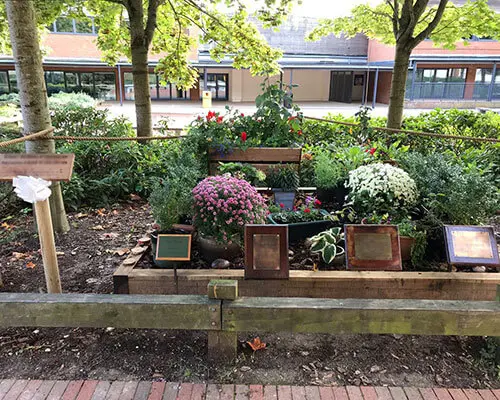
‘Every 20 minutes a parent of a child under 18 dies in the UK, that’s around 890 bereaved children each week. Many more are bereaved of a grandparent, sibling, friend, teacher, or other significant person in their life’.
(Childhood Bereavement Network, 2019-2021 statistics)
What to do when someone in the school community dies – first steps
It is almost inevitable that at some time any school will have to deal with a death of someone that impacts the whole school community.
Death is something that we do not like to think about, so when we are faced with it, we often find ourselves underprepared.
These guidelines are intended to assist your school in developing a strategy to respond to a death in the school community, including a member of staff or a pupil. Download our template policy and procedures here for more details.
Immediate actions
Bereavement Flowchart
This flowchart is designed to assist in developing a school plan for responding to bereavement.

Information sharing pathways
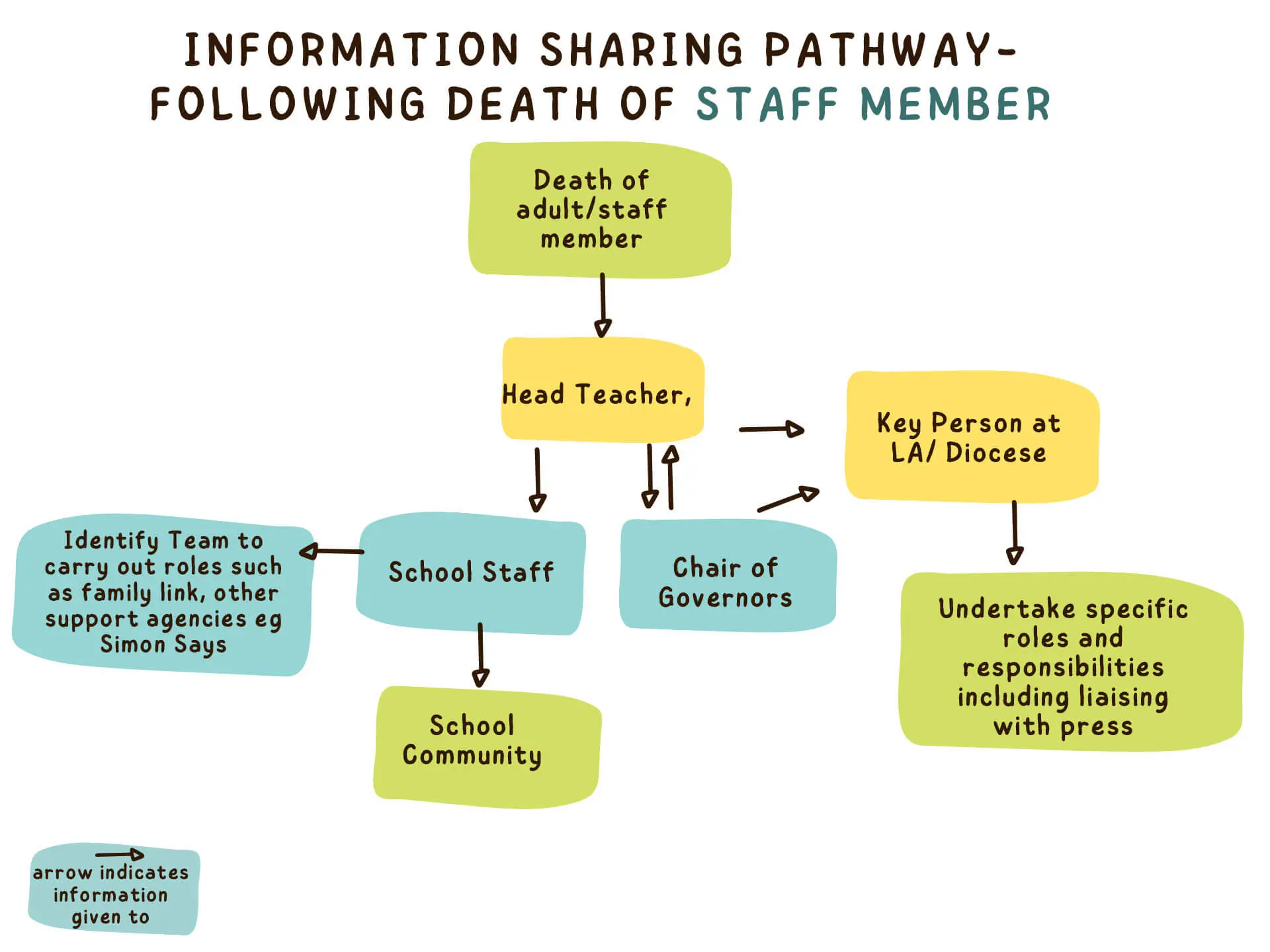
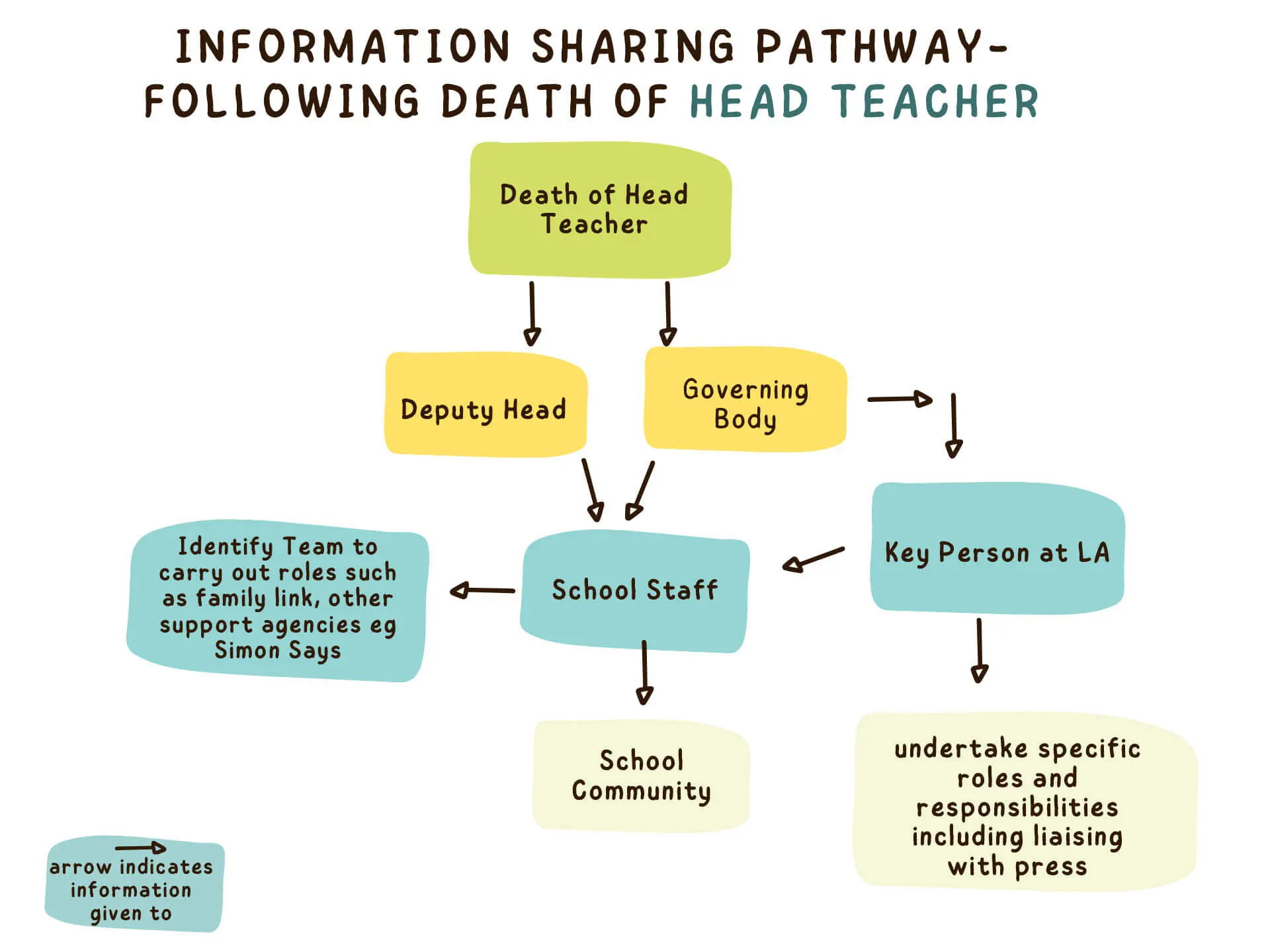
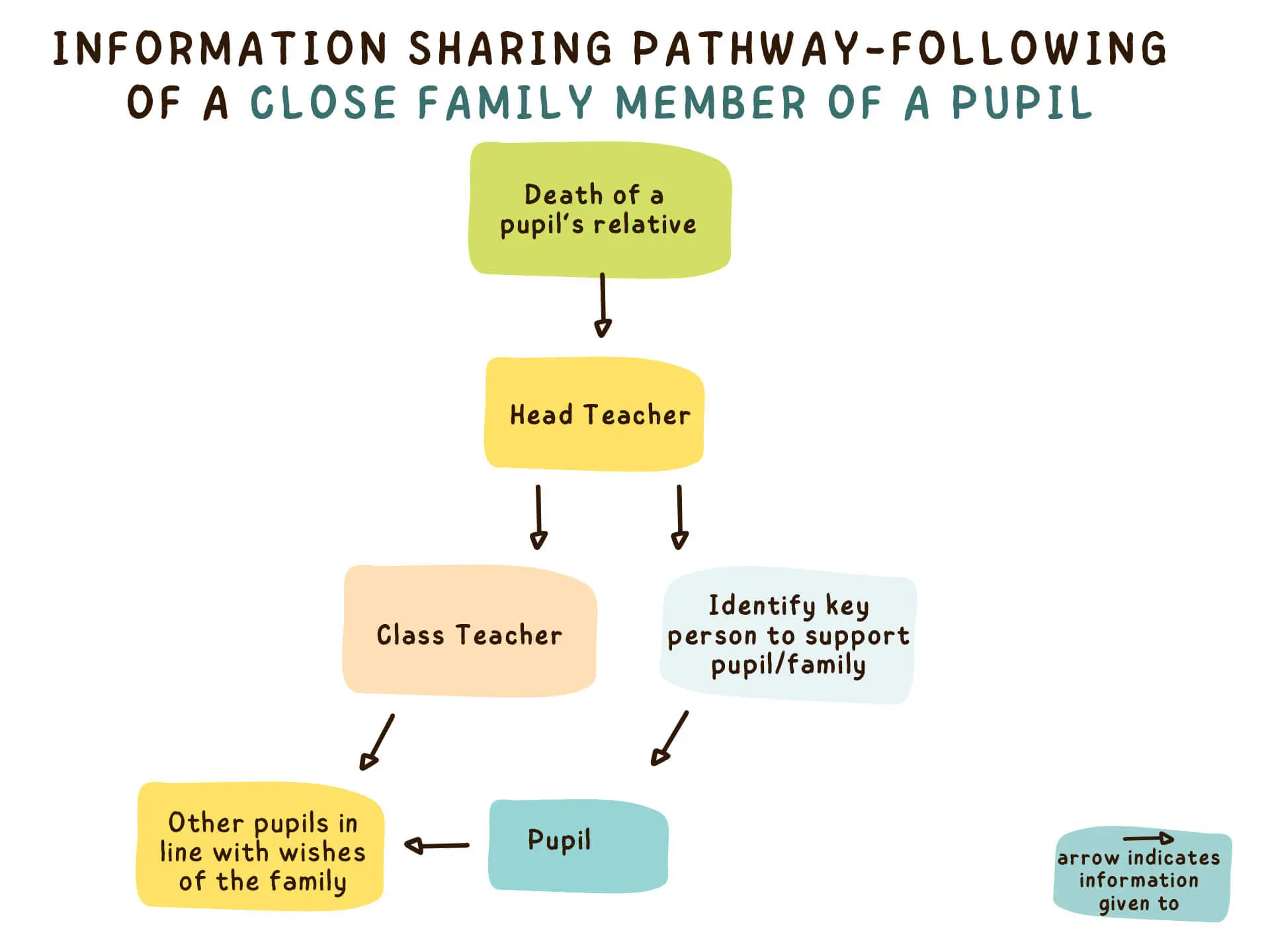
Information sharing pathways may vary depending on the staff structure at the setting and whether the school is linked to a local faith community.
Following death of staff member
Following death of Head Teacher
Following death of a pupil

Following death of a close family member of a pupil
The days following a death – practical considerations
Through the key staff member responsible for liaising with the individual’s family:
- Determine their wishes regarding who they want their story shared with and how.
- Show your support by sending a card, flowers, or set up a collection.
- Inform the family about who has been notified and what has been communicated within the setting.
It is preferable for there to be minimum disruption to the timetable, but some flexibility may be required. Identify an allocated quiet place where children, young people and staff can go if necessary. You may want to provide drawing paper, battery operated candles, mindful colouring, some books, blank cards, canvas with string and pegs to record thoughts and memories. Key people may be on hand in the quiet place to listen and respond sensitively to pupils and staff.
A death can impact the school community in various ways, often influenced by:
- The deceased person’s role within the school
- Their prominence in the local community
- The circumstances of the death, especially if it involves suicide or violence
Upon receiving news of a death, the lead person or senior management team must determine the strategy to adopt in order to respond appropriately and sensitively to the death. They should contact the family or families involved to offer condolences, support and to clarify that the information received about the death is correct. They need to consider the wishes of the family and preferences for support and information-sharing wherever possible. Announcing the news to the school community can be challenging and requires a sensitive and effective approach.
The following guidelines may help when informing staff:
- All staff should be informed as soon as possible using your normal method of communication, e.g. a whole school staff meeting or team meeting. Ensure measures are taken to inform absent and part-time staff in a telephone call if possible.
- Give a factual explanation of how the death occurred and if applicable the circumstances of what happened leading up to the death.
- Ensure Senior Leadership team, leaders and key people are prepared for reactions to this news including visibly upset and feelings of anger/guilt. People may connect the incident to their own personal experience of bereavement, so feelings about past bereavements may need to be discussed. This is perfectly natural.
- Agree a set time for teachers to inform their class about what has happened. Leaders may offer to do this or be present in the classrooms if staff request support or are unable to do this. Provide staff with a script detailing exactly what to say, to ensure consistent information is communicated to all pupils. Where possible, include answers to difficult questions that children may ask, helping staff avoid the need to come up with appropriate responses on the spot.
- Be prepared to follow this up with a special assembly, memorial service or memorial tree/garden.
- Ensure a member of Senior Leadership is available to support members of staff, parents or children if they are finding the situation particularly hard. Encourage everyone to consider how to meet their own support needs and self-care, whether through friends, family, support services, or partnering with other staff members.
- Share contact details for local support resources. Seek the advice of external support services as appropriate (e.g. Simon Says, Winston’s Wish, Child Bereavement UK, Cruse, Compassionate Friends).
Many people believe that children don’t grieve, but even very young children will have questions about what happened, how it happened, why it happened, and perhaps most importantly, what will happen next. Remember that it is ok to show your emotions in moderation. It is important staff/adults model to children and young people healthy responses to sad news. Often a natural response to hearing about a death is to shed a tear.
The following guidelines may help you to inform pupils of the death:
- Identify children who are most likely to be impacted by the news because they had a close relationship with the deceased, are newly bereaved, are vulnerable or have additional needs. Arrange for them to be told together as a separate group.
- Where possible inform pupils in the smallest group, preferably class or tutor groups. This should be done by adults they know.
- It is always a shock when a death occurs in a school even if it may have been anticipated. Use clear and simple language that is appropriate for the child’s age and stage of understanding. Use the real words ‘dead’ and ‘died’, avoiding euphemisms such as ‘passed away’, ‘lost’, ‘gone’. This is to avoid adding a layer of confusion for the pupils.
You may choose to adapt the following statement ….
“I have some very sad news to tell you which you might find upsetting. Many of you will have heard of cancer. Lots of people who have cancer do get better but for some people, they don’t get better, and they die. Mr Jones, who is our caretaker, has been ill with cancer and he sadly died yesterday in hospital.”
“Sometimes people have accidents at work, at home, at school or on the road. People may be hurt, and they may have to go to hospital for treatment. Sadly, there are some accidents that cause people to die. I have some really sad news to tell you that might upset you. Yesterday _________, who is in Year 4, was in an accident and he was so badly injured that he died.”
- Give pupils time to say what they are thinking or just to be quiet. Allow them opportunities to verbalise feelings and ask questions. Be honest, it is ok to say if you don’t have the answers but remember to revisit the question later when you do have the answer. Make notes of any such questions. Other staff may have been asked the same questions and the setting may decide on an agreed answer to these.
- Try to identify any key answers that you may need to prepare, e.g. the facts about an illness, or dates which may be relevant to the death such as end of school year and changing class or schools.
- Allow gentle discussions. Some pupils may well want to share their own experiences of the death of a loved one, even a pet and may want to share their feelings with others.
- Pupils want to do an activity to express their thoughts and feelings for instance, they may want to draw pictures, cards, write messages or create a memory board to support the family or to help each other with their feelings.
- Ensure the pupils understand that the death has nothing to do with anything they have said or done. It is in no way their fault.
- End the discussion on a positive note – not all people who are ill or have accidents die – many get better.
- Put an appropriate time limit on the discussions. It is preferable to resume normal school activities as soon as possible. This ensures minimal disruption within the school day which in itself, offers a sense of security and familiarity. However, do not expect to go straight into learning, allow for a time of restoration preferably with a physical activity outside or in a large space.
It is essential that parents and carers receive information as quickly as possible so that they can support their children and help them understand what has happened.
Most schools have text and email systems for communicating with parents, so you may want to use a combination of these methods—for example, texting parents to inform them that an important letter has been sent via email or is available for pickup when they collect their child from school.
The following script may help you to form a letter to parents:
- Your child’s class teacher had the sad task of informing the children of the tragic death of <Name>, who has been a <teacher, LSA, Lunch time supervisor…> at this school for <number> years.
- Our thoughts are with the family at this difficult time. The pupils have been gently informed today. They were told that <name> died from an illness called <cancer>. Many people who have <cancer>can get better, but other times people die from it. <Name> had been ill with <cancer> for a long time and died at home yesterday.
- When someone dies, their family and friends have lots of feelings – sadness, anger, and confusion – which are all normal. The children have been told that their teachers are willing to try and answer their questions at school, but I have made available some information which may help you to answer your child’s questions as they arise. We also have the following key people…………..who are available over the next few weeks to offer extra support to you and your children at this difficult and sad time. Please bear with us, we will update you with any new information as we receive it.
- The Hampshire based Child Bereavement Charity- Simon Says have a helpline open Monday-Friday 9-5pm if you need further support or advice. Their Helpline number is 02380 647550 or visit their website simonsays.org.uk
- We have made available the following books/our toolkit about bereavement, death and the journey of grief. We are aware that the following libraries also have a supply of Death Positive books for children and adults to borrow.
- We have been informed that the funeral will take place at <Named Church or Crematorium> on <Day and Date> at <Time>. Your child may wish to attend the funeral. If this is the case, you may collect your child from school and accompany them to the church. Please inform your child’s teacher.
- As a school, we will be holding a special assembly and some pupils will be involved in different aspects of this to remember the special person and to offer our condolences. Do contact us if you wish to receive more information about this or to discuss this further.
- Moving forwards, the school community may welcome a collaborative project to help to remember the person who died, creating something positive for everyone to share. In this way, pupils and staff may feel more connected to each other and take comfort in working together. The finished project could be shared within the school and, if appropriate, with the family of the person who died.
Ideas include…
- Audio or video messages that can be compiled within classes, tutor groups, year groups, or as a message from the entire school. These can also be recorded and collated digitally.
- Individual artworks centred around a common theme, such as a season, time of day, special place, sport, hobby, or interest. These can be uploaded to a virtual gallery.
- Plant a tree in the school grounds and children/staff add a decorated pebble around the base.
- Compile a cookbook in memory by contributing favourite recipes.
- Compose a piece of music using instruments, household items, percussion and/or singing.
- Write individual lines of poetry which could form a remembrance poem.
- Create a book of condolence which can be given to the family.
- Writing, recording or drawing messages for the family of the person who died.
- Making a jigsaw wall for which students write messages or create decorated tessellating shapes, such as paper jigsaw pieces or hexagons, which can be put together on a wall in school for display and given to the family afterwards.
- Set up an online memorial or fundraiser in memory of the person who died.
- Add a special trophy in memory of the person who died, which can be handed out each year to a pupil for a cause close to the person’s heart e.g. sport, kindness, determination, courage.


